Sabtu, 12 Maret 2011

The Utterly Indifferent

There's only one thing worse than sell-outs like Patrick Moore and that is people who have given up. They are intelligent, hard-working and socially adjusted members of the community who have simply given up on the idea of saving the environment. 


A friend of mine said the same thing very recently; he stated that there's no way destruction and exploitation in this country, Indonesia, can be averted, it is a "way of life" and it "can't be stopped." When I protested, pointing out that he often takes trips out of the city into the jungles of Sumatra, very much enjoying the environment, I suggested his attitude was very much 'last chance to see' he agreed it was, and that's why he goes there; to see it before it is gone.


In my mind it is impossibly selfish to think like that. For me the worst thing is not even that my children will never see wild apes, exotic birds or old-growth forest, or that creatures such as the Orang Utan will no longer live in the wild, or even that such damage adversely affects the planet. It is that we will have caused the unnecessary destruction of such amazing and diverse creation for our own needs and none of it will ever be seen again.


I, for one, will not sit on the fence and watch that happen.

Jumat, 11 Maret 2011

The Good, The Bad and the Utterly Indifferent

View across to the Leuser National Park, North Sumartra on a stunning day in February 2011.
A few weeks ago I wrote to Dr Patrick Moore, an ex-Greenpeace activist in the 70-80, who 'left' Greenpeace to start an 'environmental strategy' company called 'Greenspirit' (spot any similarity in the names?). 


The whole ethos of Greenspirit is 'trees are the answer' and that planting more trees will help such problems as soil degradation, erosion, global warming..and so on.
Take a guess at what type of trees they promote the planting of..you probably guessed right, yes it's palm oil trees, rubber trees and trees to be used for paper pulp. 


Essentially, Greenspirit work for APP (Asia Pulp and Paper) and Smart Tbk among others who are subsidiaries of Sinar Mas in Indonesia, the company that Nestle', Unilever, HSBC, Burger King and Carrefour have stopped buying from in the past few years because of their perceived 'unsound environmental practices'. Greenspirit write 'scientific' papers, extremely well-written rhetoric expounding the expansion of plantations throughout Indonesia ('trees are the answer', don't forget!), a country whose natural rain forests and some of the most spectacular flora and fauna in the World are under threat from complete destruction both by these plantations and by locals. 


Who has more of a right to the land?, I ask..Greenspirit will say that illegal logging is caused by poverty and 'poverty alleviation' is one of their clever heart and mind winning projects. But the locals see it as their land and their forest and we can easily suppose that these villagers cause substantially less damage than a major planting and logging operation. 


One thing that is certain is that the land of Indonesia does not belong to foreign companies like Greenspirit or by foreign investors but they are the ones making the profit in an ever expanding industry.


I'll admit my email to Dr Moore was somewhat emotive;


Greenspirit/Mr Patrick Moore,

I see. So, the Patrick Moore/Sinar Mas philosophy is 'let's cut down those old trees so we can plant nice new trees, because new trees are surely better than those horrible old ones'.
It is complete nonsense and unfortunately the kind of misinformation people can be made to believe, particularly SE Asians who often only see the monetary value of things not their intrinsic worth.
All Moore is, is a environmental consultant being paid to write eco-propaganda that suits the needs of APP/Sinar Mas and probably more than a few politicians (in more than a few countries). He is, indeed, quite contrary on almost all issues, which puts him in a fair few pockets in Canada and the US as well.

The destruction of old growth forests and peat lands releases many times more carbon into the atmosphere than any plantation forest can hope to capture over many years. Depletion of old growth forest leads to lack of food which leads to extinction of species and slowly puts an end to diversity. Roads and logging tracks cut up territory into smaller and smaller sections which many animals, birds and insects will not choose to leave.

Perhaps Mr. Moore will suggest cutting down the rest of Leuser National Park in Sumatra, relocating the remaining +/- 7000 Sumatran Orangutan to a plantation near him and seeing if he can live with watching them all die.
It’s all just dollar signs. I have seen plenty of plantations first hand and they are almost completely lacking in any biodiversity, due to the very nature of the plantation forest being a single species of tree or plant, not to mention the amount of daily human activity inside the forests (in the case of rubber and palm), it is not somewhere where animals choose to live, especially not for the short period before the trees are harvested, usually 5-15 years in the case of fast-wood fibre farms.
Patrick Moore is a businessman, getting rich from offering ‘advice’ to people who don’t know any better. Please check out his website www.greenspirit.com where you will see all of his brilliant money-making policies in the making. There is also a link to ‘Paradise with an Ocean View’ vacations in Cabo Pulmo, on the Sea of Cortez, Baja, Mexico.
Yes, it must be lovely Patrick. Will you be inviting all of your Indonesian peasant plantation workers for a vacation, too? Then you can show them just how many American dollars their labour has created for you.

I believe you once did great work with Greenpeace in the 1970's and 1980's, the kind of work people of my generation respect and praise men like you for.
However, whatever the motives for your change of perspective may be, you are making no friends in our neighbourhood today, sir.

Yours Faithfully,

AES, a concerned British resident in Sumatra

To which Dr Moore managed to answer;


Hello Andrew,

Here is the report we prepared for APP.
Please communicate in a civil manner and I may engage in conversation with you.

Cheers, Patrick Moore

Seems as though I touched a nerve.

Kamis, 17 Februari 2011

Pass the buck, and let the Rupiah roll in.

What is the value of this piece of land in it's current state?
Is it better to leave it as wasteland or to plant a forest on it? 

Scrubland and village complex near Bohorok, not far from Bukit Lawang which borders the Leuser Rainforest Ecosystem in  North Sumatra
Image © otherworldadventures 2011, with permission.


It has been a surprising week for me. I openly attacked a veteran eco-activist turned corporate consultant because I dislike the industry that he now represents. It was an emotive letter and I got what I deserved, I guess. He fought back, challenging me to read his company, Greenspirit's, last report which defends the expansion of pulp-wood plantations in Sumatra.
They are very defensive but it is cleverly written and they make some strong arguments and have caused me to examine whether ecology and economy can 
exist side by side.


The plantation companies insist that they can..but can they and the government be trusted? 
The environmental groups insist that they cannot and that blind greed and destruction are the only cause and effect.. but are they deliberately obtuse and not even trying to see the big picture?


Logging companies' point of view-
http://www.scribd.com/doc/42850998/Plantation-Forestry-in-Indonesia-The-Greenspirit-Strategies-Perspective
Greenpeace's point of view-
http://www.greenpeace.org/international/en/publications/reports/SinarMas-APP/


I need a few days of research and digestion before I can write anything objectively :)


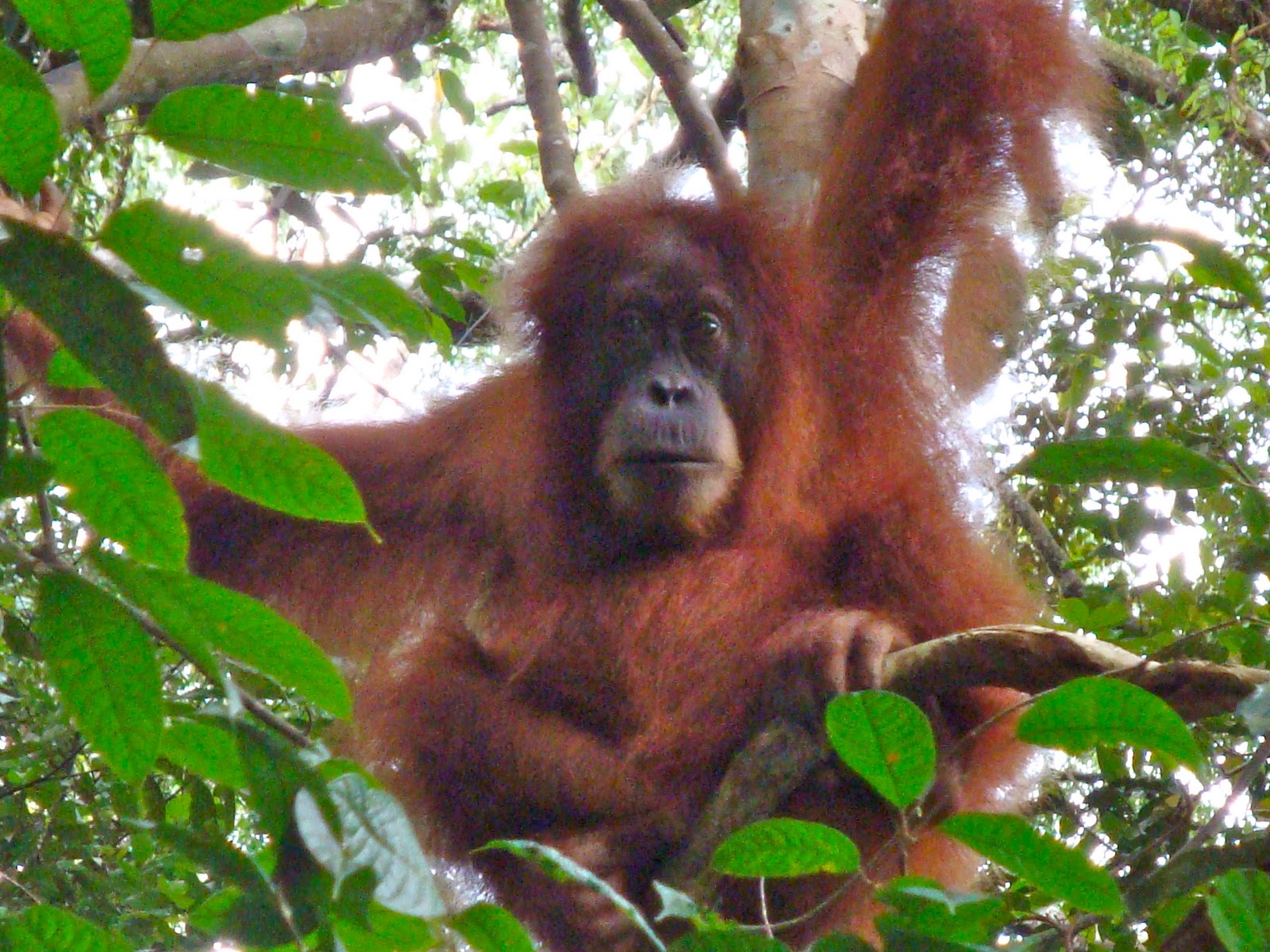
I'll leave you with this guy who I photographed in the wild in Gunung Leuser National Park June 2009

Rabu, 16 Februari 2011

Putting a Price on Nature

Conservation doesn't 
come cheap.


An Indonesian coin worth 100 Rupiah dated 1978 declares "Hutan Untuk Kesejahteraan" or 'Forestry for Prosperity.'


Given the level of 'prosperity' seen on the streets of Sumatra 33 years later, it obviously hasn't provided the average Indonesian with much wealth or prosperity.


All that foreign companies have done is to make themselves wealthy and demonstrate to Indonesian villagers that there is a lucrative market for illegal hardwood timber which is easily exploited.


Selasa, 15 Februari 2011

The Start of A Long and Unfamiliar Road

I am ever a stranger in this very familiar country, Indonesia..

Every time I leave my home it's clear to only me, that no matter how many years pass and how comfortable I become with living here, it will always be assumed by Indonesian people that I am an outsider, a tourist, in a place that I completely, and indefinitely, consider to be my home. There's no big 'graduation from Englishman to Indonesian' ceremony, no insignia or tattoo to wear that shows locals that one has committed an unquantifiable amount of ones time, energy, life to their country and its people, in my case its young people in my classrooms. 

Not that it matters, of course..I still love this enormous, beautiful, mixed-up country that has given me a loving wife and a wonderful daughter and son..the country of "Hello Mister", of welcoming and accepting people, the country whose natural beauty never let me leave and never fails to surprise and excite and make you feel like you have just arrived with a huge rucksack and way too much fancy gear. 


'No nation is perfect', and for no nation would this be more true than for Indonesia. However, many of its woes are beyond my comprehension and, more than that, as a foreigner I would be mistaken to believe that they are any of my business. I also refuse to blog for blogging's sake and do not suppose that I am talented or witty enough to deserve a following for stories about my favorite Pizza restaurant or which side of the bed I got up on today. (*)


However, I do wish to make one Indonesian woe, my business: 
The striving for conservation and sustaining of pioneer flora and fauna biodiversity within the vast and dense forest and mangrove ecosystems on the spectacular island of Sumatera (**). That is; protecting the forests in their 'original state',
something that caught my attention when I first visited the rainforest of Aceh in 2001 and I have been unable to forget. 


In Indonesia things often get hazy and lost in translation, even though it is democratic and people embrace freedom of speech and of press, the language is a serious barrier and cultural ethics and traditions, which are sometimes unintelligible to foreigners, often shape decision-making processes. The public have much less tolerance for corruption and nepotism, but they remain ever-present obstacles. In my opinion, education and reliable information is a most valuable contribution, to enable adults and children to understand the issues involved and to formulate their own opinions. 

To this end, and as much for my own development as for any reason, I endeavour to analyse and report as best I can on the changes and activities, both positive and negative, in my immediate environment of the Mount Leuser National Park, and other parks in Aceh, Riau (***) and West Sumatra which are of immense environmental importance, both locally and on a global scale. 


(*) Papa Rons, and the right-hand side.
(**) Old spelling of Sumatra
(***) Aceh - the Northernmost province of Sumatra.
       Riau - the Eastern part of Sumatra opposite Singapore 
       and Kuala Lumpur in Malaysia.